
5 Ways Sensory Bins Boost Vocabulary & Language Skills
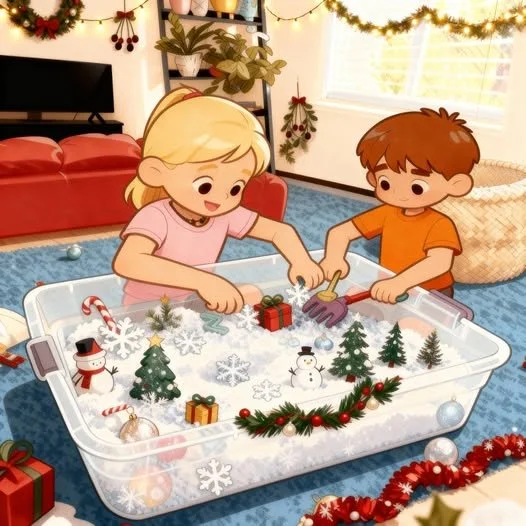
1. Rich, natural vocabulary exposure
Kids learn words in context—think: “scoop,” “pour,” “sink,” “float,” “sticky,” “cold,” “smooth,” “grainy,” “sparkly.” Real objects make abstract words meaningful.
2. Built-in opportunities for communication
Sensory play encourages turn-taking, commenting, asking for help, making choices, and following directions.
Examples: “More beans?” “Find the star,” “Can you hide it again?” “Let’s pour it together.”
3. Perfect for modeling language at any level
From single words (“ball!” “in!” “shake!”) to expanded phrases (“I found a tiny snowman!”), sensory bins meet every child where they are.
4. Encourages pretend play
Pretend play supports narrative skills, sequencing, problem solving, and emotional language. Sensory bins naturally turn into little worlds for stories.
5. Supports regulation + attention
The tactile input can help kids stay calm and focused, opening the door for more engagement and more language.
Winter-Themed Sensory Bin Idea:
Fill: fake snow, cotton balls, jingle bells, mini ornaments, little animals.
Target words: cold, snow, rolling, shake, shiny, soft, under, on top, matching.
Play ideas: “Dig to find the bells,” “Hide the ornament under the snow,” “Make a snowy path for the reindeer.”
#slp#slplife#pediatricslp#earlyintervention#speechtherapy#speechpathology#sensoryplay
--
Nicole Griffith
Owner, SLP
Super Speech Therapy
